Here is a scene that plays out thousands of times a day. Someone starts researching a cruise vacation, filters by "luxury," sees fares starting at $5,000 per person for a week, and immediately clicks back to the mainstream options at $899. Case closed. Luxury cruises are for the wealthy. End of discussion.
Except that math is wrong. Not a little wrong — fundamentally wrong. And the cruise lines on both sides of the equation are perfectly happy to let you stay confused, because the mainstream lines want you to think their base fare is the real price, and the luxury lines are content to attract travelers who do not bother comparing.
We did the actual comparison. We tallied every realistic cost for a 7-night Mediterranean cruise on both a mainstream and a luxury line, and the results changed how we think about cruise pricing entirely.
Mainstream lines advertise the floor; luxury lines advertise the ceiling. Once drinks, Wi-Fi, gratuities, excursions, and specialty dining land on the mainstream bill, the gap collapses to less than half of what the marketing implies.
Round 1 of 3 · the money
The cruise industry has a pricing transparency problem, and it cuts in both directions.
Mainstream lines advertise aggressively low fares — $899, $1,099, sometimes even $599 for a balcony cabin. These numbers are real, but they are the beginning of your spending, not the end. What they do not mention in the banner ad is that drinks will cost you $80 per day, Wi-Fi is $20 per day, gratuities are automatically charged at $18 to $22 per day, shore excursions run $75 to $200 each, and the two specialty restaurants you actually want to try have $50 to $85 cover charges. By the time you step off the ship, your $899 cruise cost you $2,500.
Luxury lines have the opposite problem. They quote all-inclusive fares that look eye-watering — $5,500 to $9,000 per person for a week — but that number is genuinely close to your final cost. There is nothing lurking behind it. No drink charges, no Wi-Fi fees, no tip envelopes, no excursion upsells. You board, you enjoy, you leave.
The result is that most travelers compare a half-price against a full-price and conclude luxury costs five times more. It does not.
We priced a realistic 7-night Western Mediterranean — Barcelona, Marseille, Florence, Rome, Naples — for a couple who drinks moderately, wants Wi-Fi, plans an excursion in most ports, and will try a specialty restaurant twice. Not extravagant travelers. Normal vacationers who want to enjoy themselves without constantly worrying about the bill.
Mainstream all-in lands at roughly $2,750 per person ($1,400 base + $560 drinks + $140 Wi-Fi + $140 gratuities + $500 excursions + $80 specialty + $30 room service + $40 laundry). The Regent Seven Seas all-inclusive comes in at $6,500 per person, and that is the final number — not the starting one. The full per-line breakdown is in the receipts table at the bottom.
The real gap is about 2.4×, not 4.6×. For that 2.4× premium you get a suite nearly twice the size of the mainstream cabin, a ship with one-seventh the passengers, roughly one crew member for every 1.4 guests instead of one for every 3, and the complete absence of financial friction for the entire week.
The math: mainstream's $899 ad is a down payment on a $2,750 vacation. Luxury's $6,500 quote is the whole vacation. The honest spread between the two is closer to 2.4× than 5×.
Round 2 of 3 · what's actually in the box
Not all luxury lines include the same things. Here is the honest breakdown.
(https://www.gocruisetravel.com/en/guides/undefined) (GoCruiseTravel Perk Score: 98/100) is the gold standard of all-inclusive. Every suite has a balcony. The fare covers all drinks (including top-shelf spirits), all dining, unlimited Wi-Fi, unlimited shore excursions, gratuities, and pre-cruise hotel nights on select sailings. Business-class airfare is included on select longer voyages. There is essentially nothing left to pay for except spa treatments and the onboard boutique.
(https://www.gocruisetravel.com/en/guides/undefined) (GoCruiseTravel Perk Score: 95/100) includes all drinks, all dining, butler service in every suite category, Wi-Fi, and gratuities. Shore excursions are not included in the base fare but are offered through periodic promotions. The butler service is genuine — your butler will unpack your luggage, draw you a bath, arrange in-suite canapes for cocktail hour, and handle restaurant reservations.
(https://www.gocruisetravel.com/en/guides/undefined) (GoCruiseTravel Perk Score: 93/100) matches Silversea's inclusions — all drinks, all dining, Wi-Fi, gratuities — and emphasizes culinary excellence across its restaurants, including the signature venue Solis. Every dining venue is included with no cover charge or surcharge.
Oceania is more selective. All dining venues are included (and the food is arguably the best at sea, thanks to Jacques Pepin's involvement), along with basic Wi-Fi and gratuities on most sailings. Drinks are not automatically included but are frequently bundled through the OLife Choice promotion, which offers a pick of free drinks, free excursions, or onboard credit.
Viking includes an excursion in every port, all dining, beer and wine with lunch and dinner, basic Wi-Fi, and access to the thermal suite spa. Spirits and cocktails are not included in the base fare. Viking does not consider itself "luxury" — it prefers "premium" — but the experience lands squarely in the upper tier.
(https://www.gocruisetravel.com/en/guides/undefined) (GoCruiseTravel Perk Score: 88/100) (MSC's luxury brand) includes all drinks, all dining, Wi-Fi, and gratuities. Shore excursions are available at additional cost, though promotional credits are sometimes offered. Ships carry around 900 guests in an all-suite, all-balcony configuration with a contemporary European design sensibility that feels refreshingly different from legacy luxury lines.
The financial comparison matters, but it does not capture everything. Some differences are harder to quantify and impossible to ignore once you have experienced them.
Space per passenger. A mainstream mega-ship devotes roughly 30 to 40 gross tons per passenger. A luxury ship allocates 60 to 80. You feel this everywhere — hallways that are not crowded, pool decks where you can actually find a chair, restaurants where tables are spaced far enough apart that you cannot hear the next couple's conversation.
Port selection and timing. Luxury lines visit ports mega-ships physically cannot reach — smaller harbors in the Greek islands, the Croatian coast, remote Norwegian fjords. When they do visit major ports, they often arrive earlier or stay later than mainstream ships, giving you the city before or after the day-tripper crush.
Noise levels. This sounds trivial until you experience the difference. A ship with 750 guests at dinner is a murmur. A ship with 5,400 guests at dinner is a roar. The cumulative effect on your nervous system over seven days is significant. Many luxury converts say the quiet is what they noticed first and what they miss most.
Dining breadth. On Regent's Splendor, every one of the ship's seven restaurants is included in the fare. You eat at the French restaurant one night, the steakhouse the next, the pan-Asian venue after that — never the same place twice if you do not want to. On a mainstream ship with eight specialty restaurants, you are doing math every night: is this dinner worth $65?
Who wins this round: the box on a luxury ship contains roughly twice the cabin, half the crowd, three times the crew ratio, and zero spreadsheet-keeping. The box on a mainstream ship contains a basecamp and an upsell menu.
 Seven Seas Splendor leaving Tallinn — 750 guests, seven restaurants, every dining venue included in the fare. Photo: Pjotr Mahhonin / Wikimedia, CC BY-SA 4.0.
Round 3 of 3 · the bridge tier
If this article has a thesis, it is this: the most interesting value proposition in cruising right now is not at the top or the bottom of the market. It is in the middle — specifically, Oceania and Viking.
(https://www.gocruisetravel.com/en/guides/undefined) (GoCruiseTravel Perk Score: 82/100) delivers what many travelers actually want from a luxury cruise — extraordinary food, a smaller ship, and a destination-focused itinerary — at prices often within striking distance of a fully loaded mainstream fare. A 7-night Oceania sailing during a promotional period, with drinks included, might cost $3,800 per person. That is $760 more than our mainstream all-in calculation, for a fundamentally different experience.
(https://www.gocruisetravel.com/en/guides/undefined) (GoCruiseTravel Perk Score: 85/100) offers a similar value proposition with a different emphasis. Where Oceania leads with food, Viking leads with destinations — an included excursion in every port, itineraries designed around cultural enrichment, and onboard programming that features local speakers, regional cuisine, and destination-focused content. The adults-only policy and the absence of a casino create an atmosphere that is calm without being stuffy.
Both lines serve as a bridge. They give mainstream cruisers a taste of what smaller ships and better inclusions feel like, without requiring a leap to $6,500 per person. And for many travelers, that bridge is one-way — once you have experienced it, the mega-ship holds less appeal.
The math: roughly 80% of the luxury experience for 40% of the Regent premium. Best place to land for someone trading up from mainstream.
 Oceania Vista in port at Dubrovnik — 1,200 guests, every dining venue included, ~$3,800 per person all-in during a promo window. Photo: RL0919 / Wikimedia, CC BY-SA 4.0.
Who luxury cruising is not for
Honesty requires saying this plainly: luxury cruises are not for everyone, and spending more does not automatically mean enjoying more.
Party seekers and nightlife lovers. If your ideal cruise night involves a packed club, a DJ until 2 AM, and a casino buzzing with energy, luxury ships will bore you. Evening entertainment leans toward guest pianists, classical ensembles, and enrichment lectures. The bars close earlier. The energy is mellow.
Families with young children. Most luxury lines have no kids' clubs, no water parks, no teen lounges, no programming for children. Viking is strictly adults-only. Bringing a seven-year-old on a Seabourn ship is technically possible but practically miserable — for the child and for everyone around them.
Waterslide and mega-ship enthusiasts. If you love the sheer spectacle of a (https://www.gocruisetravel.com/en/guides/undefined) (GoCruiseTravel Perk Score: 45/100) Icon-class vessel — surf simulators, zip lines, Central Park, robotic bartenders — a 750-passenger luxury ship will feel empty by comparison. The wow factor on luxury ships comes from refinement, not scale. If scale is what thrills you, lean into it.
Budget-constrained travelers. Even after adjusting for the true all-in cost, luxury cruises are more expensive. If the difference between $3,000 and $6,500 per person is meaningful to your finances, the mainstream option is the right call. A great vacation on a mainstream ship is infinitely better than a financially stressful one on a luxury ship.
The Four Seasons signal
The Four Seasons I yacht debuted in early 2026, bringing the hospitality brand's land-based luxury standard to the water. With just 95 suites and fares that start well above even Regent's pricing, it occupies the ultra-premium tier — more private yacht than cruise ship.
What matters about Four Seasons' entry is not the ship itself but what it signals about the market. When one of the world's most recognizable luxury hospitality brands decides the cruise industry is worth entering, it confirms what the numbers already show: demand for high-end cruise experiences is growing faster than demand for mainstream ones. Travelers are increasingly willing to pay for inclusion, intimacy, and quality over size and spectacle.
Ritz-Carlton (with their Evrima yacht) entered the same space in 2022. Aman has announced plans. The convergence of luxury hotel brands and cruising suggests the future of the industry is not just bigger ships — it is also better ones.
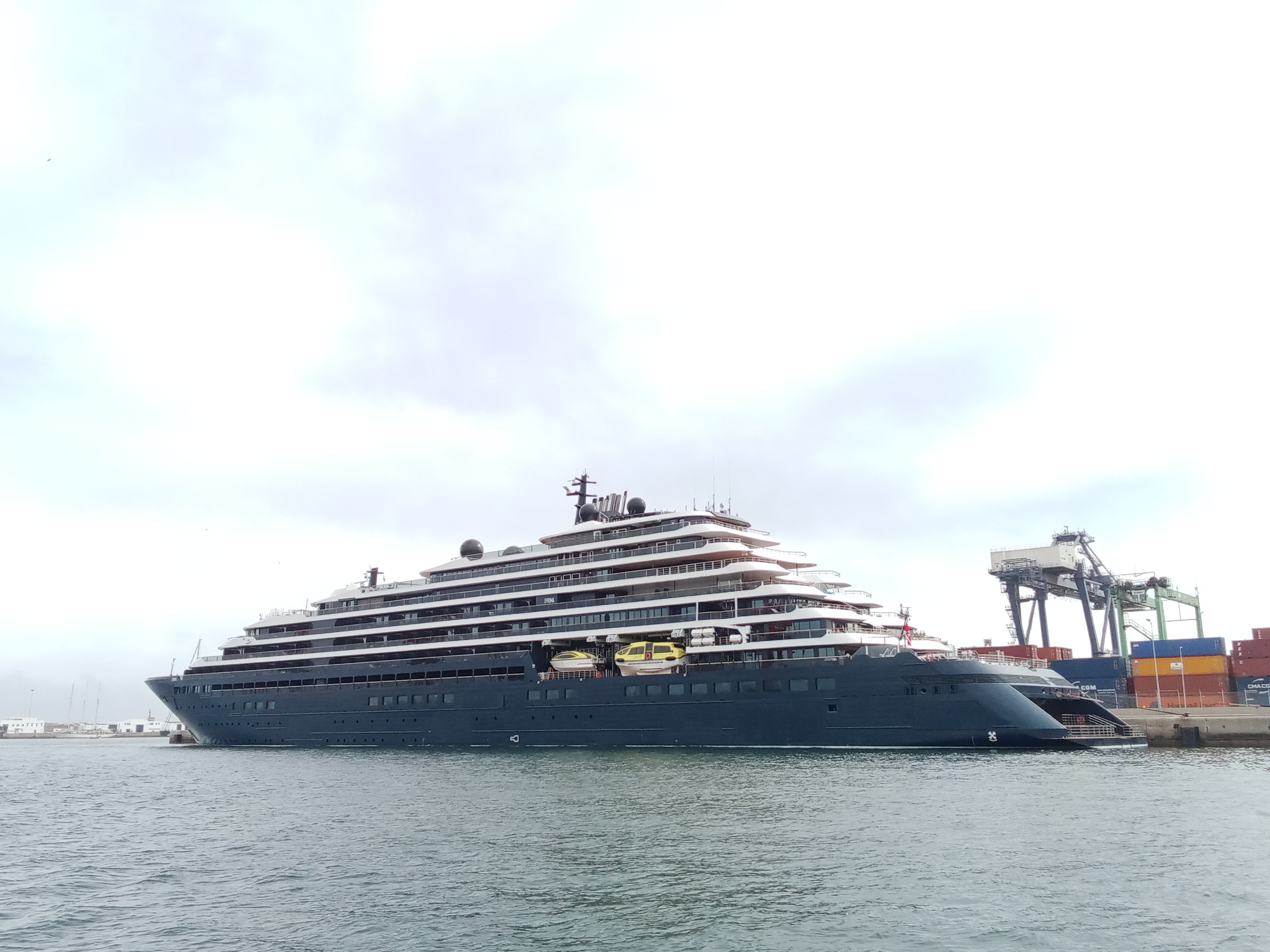 Ritz-Carlton's Evrima at port — the hospitality-brand yacht template, 2022 debut. Four Seasons I (debuted 2026) sits in the same tier; Commons imagery for the Four Seasons ship not yet available, sister concept shown. Photo: Farid mernissi / Wikimedia, CC BY 4.0.
Who actually wins
Three outcome paths, depending on what you actually care about:
- If you care about food and quiet, and are tired of nickel-and-dime math → Oceania or Viking. The bridge tier is built for you. ~$3,500–$4,500 per person all-in, every dining venue included, ~1,200 guests on board.
- If you want zero-friction luxury and price isn't the question → Regent Seven Seas or Silversea. Everything is in the fare; nothing is left to pay for. ~$6,500–$9,000 per person, the math is done.
- If you want scale, nightlife, families, or budget headroom → mainstream, full stop. The all-in cost still lands at ~$2,750 per person, the kids' club is real, and the energy is the point. Don't let the all-in math alone push you to luxury — it is a different vacation, not just a more expensive one.
The receipts
7-night Western Mediterranean, per person, balcony / veranda suite, couple booking together. All numbers verified against current fare sheets and onboard pricing as of May 2026.
| Expense | Mainstream (Royal Caribbean) | Luxury (Regent Seven Seas) |
|---|---|---|
| Base fare | $1,400 | $6,500 |
| Drink package ($80/day × 7) | $560 | Included |
| Wi-Fi ($20/day × 7) | $140 | Included |
| Gratuities ($20/day × 7) | $140 | Included |
| Shore excursions (5 ports) | $500 | Included (unlimited) |
| Specialty dining (2 nights) | $80 | Included (all venues) |
| Room service surcharges | $30 | Included |
| Laundry (1 load) | $40 | Included |
| Total per person | $2,750 | $6,500 |
| Total for couple | $5,500 | $13,000 |
| Per person per night | $393 | $929 |
| Cabin size | 182 sq ft | 307 sq ft (suite) |
| Guests on board | ~5,400 | ~750 |
GoCruiseTravel's Luxury Cruise Worth It Verdict
Based on GoCruiseTravel's Perk Score analysis, luxury cruising is unambiguously worth it for couples and adult groups who were already planning to buy drink packages, excursions, and Wi-Fi on a mainstream ship — because the all-in gap is 2.4×, not 5×. Regent Seven Seas (Perk Score 98/100) and Silversea are the right call when only the best will do. Oceania (82/100) and Viking (85/100) are the smarter starting point for luxury newcomers — roughly 80% of the experience at 40% of the Regent premium. Luxury is not the right call for families with young children, mega-ship enthusiasts, or anyone wanting the nightclub energy of luxury vs mainstream cruise line comparison (https://www.gocruisetravel.com/en/guides/luxury-vs-mainstream-cruise-lines). For a different cost-breakdown angle, see river vs ocean cruise cost breakdown (https://www.gocruisetravel.com/en/guides/river-vs-ocean-cruises).

Six Luxury Cruise Lines Say 'All-Inclusive.' Only One Actually Means It.
On luxury cruises 'all-inclusive' now means six different things — Regent still includes every shore excursion; Four Seasons won't include dinner.


