Northern Europe is the runaway story of the 2026 cruise season. Bookings are up dramatically — (https://www.gocruisetravel.com/en/guides/undefined) (GoCruiseTravel Perk Score: 65/100) reports Northern Europe up roughly 50 percent year over year, with other lines seeing similar surges. Every major cruise line has repositioned tonnage northward. (https://www.gocruisetravel.com/en/guides/undefined) (GoCruiseTravel Perk Score: 85/100), Holland America, (https://www.gocruisetravel.com/en/guides/undefined) (GoCruiseTravel Perk Score: 72/100), (https://www.gocruisetravel.com/en/guides/undefined) (GoCruiseTravel Perk Score: 68/100), and Hurtigruten have all added new itineraries or expanded existing ones.
The reasons are not mysterious. Travelers want destinations that feel safe and stable. Norway and Iceland deliver that in abundance. The Middle East turmoil has pushed ships back to European waters, and cruisers who might have booked the Arabian Gulf are discovering that a Norwegian fjord at midnight, bathed in golden light that never quite fades, is worth every penny of the reallocation.
This is also the region where cruising makes the most sense as a travel format. These coastlines were built for ships. The fjords are waterways. The villages cling to shores. You are not transferring 90 minutes from port to city — you are stepping off the gangway into the heart of it.
Why 2026 Is the Year
Three forces converged. First, ships that were deployed to the Middle East and Red Sea in 2024–2025 needed new homes as regional instability persisted. Northern Europe absorbed that capacity. Second, post-pandemic travelers have shifted decisively toward nature-forward, uncrowded destinations — and nothing says "uncrowded" like a village of 300 people at the end of a fjord. Third, climate awareness has made the Arctic and sub-Arctic feel urgent. People want to see glaciers before they recede further. They want to witness the landscapes while they still look like this.
The result: more ships, more itineraries, more competition, and — crucially — better pricing than you might expect for a region this spectacular.
Norwegian Fjords: The Greatest Hits
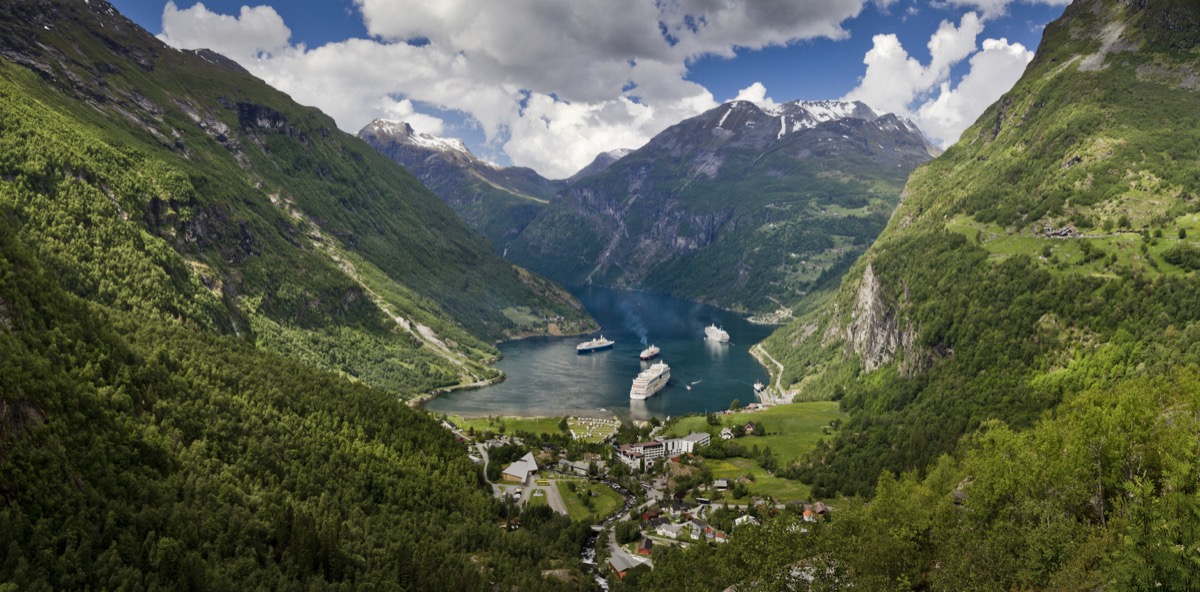
Norway's western coast is the crown jewel of Northern European cruising, and it is not close. The fjords are geological cathedrals — sheer cliff walls rising up to 1,400 meters from water so still it mirrors the sky perfectly.
Geirangerfjord is the icon. UNESCO-listed, absurdly dramatic, with waterfalls cascading directly into the fjord from hanging valleys above. The ship inches through a narrow channel while passengers stand on deck in stunned silence. It is the single most visually overwhelming moment in European cruising.
Sognefjord is Norway's longest and deepest — 205 kilometers of branching waterways that feel like sailing into the spine of the earth. The village of Flam sits at the inner end, and the Flam Railway from sea level to mountain plateau is one of the world's great train journeys. Do not skip it.
Bergen is the gateway city and deserves more than a quick walk through Bryggen wharf. Take the Floibanen funicular to the top of Mount Floyen for panoramic fjord views, then lose yourself in the fish market and the narrow wooden streets of the old quarter.
Tromso, above the Arctic Circle, is the launchpad for midnight sun experiences in summer and northern lights in autumn. The Arctic Cathedral alone is worth the visit — a striking modernist building that looks like a frozen wave.
Iceland Circumnavigation: The New Must-Do
Iceland has gone from niche expedition territory to mainstream cruise destination in five years. The circumnavigation itinerary — a full loop around the island over 8–10 days — is the hottest ticket in Northern European cruising right now.
Reykjavik is the start and end point. Spend a pre-cruise day here at minimum. The Golden Circle (Thingvellir, Geysir, Gullfoss) is a non-negotiable day trip. The city itself is compact, colorful, and packed with excellent restaurants serving lamb, seafood, and skyr in every conceivable form.
Akureyri, the capital of the north, is the gateway to Godafoss waterfall and the surreal Myvatn volcanic landscape — boiling mud pots, lava formations, and an otherworldly silence.
Husavik is Europe's whale watching capital. Humpbacks, minkes, and occasionally blue whales feed in Skjalfandi Bay. A whale watching excursion here is not a gamble — sighting rates exceed 95 percent in summer.
Isafjordur in the Westfjords is raw, remote Iceland at its most dramatic. Towering table mountains, virtually no tourists, and a sense of being at the edge of the habitable world.
Baltic Capitals: Culture at Every Stop
The Baltic itinerary is Northern Europe's urban counterpart to Norway's nature. Stockholm, Helsinki, Tallinn, and Copenhagen deliver world-class museums, architecture, and food in compact, walkable cities.
Stockholm spread across 14 islands is jaw-dropping from the water. The Vasa Museum (a perfectly preserved 17th-century warship) and Gamla Stan (the old town) are essential. Budget a full day.
Tallinn is the sleeper hit. A medieval walled city that looks like a fairy tale, with cobblestone streets, Gothic spires, and some of the best-value dining in Northern Europe. Most cruisers are shocked by how beautiful it is.
Helsinki is understated and design-obsessed. The Market Square, Suomenlinna sea fortress, and the city's modernist architecture reward the curious traveler.
Copenhagen is the most common embarkation port and deserves two days if you can manage it. Nyhavn, Tivoli, and the food scene (this is the city that gave us Noma) are all outstanding.
Note on St. Petersburg: most Baltic itineraries have replaced the Russian port call with additional time in Tallinn, Helsinki, or a stop in Riga or Gdansk. Honestly, Tallinn and Helsinki have filled that gap remarkably well.
British Isles and Scottish Highlands
The British Isles loop is Northern Europe's most underrated itinerary. Edinburgh, the Scottish Highlands, Orkney, the Irish coast, and Liverpool offer a staggering range of landscapes and history in a single voyage.
Orkney is the revelation. Five-thousand-year-old Neolithic sites (Skara Brae, the Ring of Brodgar) predate the pyramids. The islands are windswept, green, and hauntingly beautiful.
Edinburgh from the port of South Queensferry puts you within striking distance of the castle, Royal Mile, and Arthur's Seat. A city that delivers on every level.
The Scottish Highlands by tender — some smaller ships call at places like Portree on the Isle of Skye or Invergordon near Loch Ness. These are the ports where you feel genuinely remote.
Best Cruise Lines for Northern Europe
Viking dominates this region and deserves to. Purpose-built expedition and ocean ships, Scandinavian design, included excursions, and itineraries that prioritize destination depth over onboard flash. If you are doing Norway or Iceland for the first time, Viking is the default recommendation.
Hurtigruten is the original Norwegian coastal voyage — part cruise, part ferry, part cultural immersion. Their ships call at 34 ports along the Norwegian coast, many of them tiny villages no other cruise line visits. It is not luxury. It is authentic.
Holland America has deep roots in Northern Europe and offers excellent Baltic and Norwegian itineraries on mid-size ships. The Rotterdam and Nieuw Statendam are particularly well-suited to the region.
Celebrity brings its premium polish to Northern Europe with Edge-class ships like Celebrity Apex on Norwegian fjord itineraries and Celebrity Silhouette running Iceland routes. Outstanding food and modern design.
Cunard offers the classic transatlantic crossing from New York or Southampton followed by Northern European itineraries. If you want the grand voyage feel — formal nights, afternoon tea, the Queen Mary 2 cutting through the North Atlantic — Cunard is unmatched.
| Itinerary Type | Duration | Highlights | Best For |
|---|---|---|---|
| Norwegian Fjords | 7–10 days | Geirangerfjord, Bergen, Flam, Tromso | Nature lovers, photographers, first-timers |
| Iceland Circumnavigation | 8–12 days | Reykjavik, Akureyri, Husavik, Westfjords | Adventure seekers, geology buffs, wildlife fans |
| Baltic Capitals | 7–12 days | Stockholm, Helsinki, Tallinn, Copenhagen | Culture and history enthusiasts, architecture fans |
| British Isles | 10–14 days | Edinburgh, Orkney, Dublin, Liverpool | History buffs, Anglophiles, whisky lovers |
| Norway + Iceland Combo | 14–18 days | Fjords plus full Iceland loop | Those who want the complete Northern Europe experience |
When to Go
June (Midnight Sun): The magic month. Above the Arctic Circle, the sun never sets. Temperatures are pleasant (12–18°C), the fjords are at peak beauty with snowmelt waterfalls in full force, and the light at midnight is ethereal — golden, horizontal, cinematic. This is the most popular month for good reason.
Holland America's reported growth figure, with Viking, Celebrity, and Hurtigruten seeing similar surges. Driven by travelers seeking safe, nature-forward destinations as Middle East deployments scaled back.
July–August: Warmest weather (15–22°C), longest days everywhere, and peak family travel season. Prices are highest. Ports are busiest. Still spectacular.
May and September: Shoulder season. Cooler (8–14°C), fewer ships, lower prices, and a different beauty — snow-capped peaks in May, autumn colors in September. September also brings the first aurora sightings above the Arctic Circle.
October–March (Aurora Season): Only Hurtigruten and a handful of expedition lines operate Norwegian coastal voyages in winter. You trade scenery for the northern lights — a worthwhile trade if you dress warmly and embrace the darkness.
What to Pack
Layering is not optional — it is the entire strategy. A typical fjord day starts at 8°C with mist, warms to 16°C in afternoon sun, and drops back to 10°C by evening. You need:
- A waterproof, windproof outer shell (not a fashion raincoat — a real one)
- Fleece or lightweight down mid-layer
- Thermal base layers for Arctic ports and early mornings
- Sturdy walking shoes with grip (cobblestones in Bergen, volcanic rock in Iceland)
- Hat, gloves, and a buff/scarf — even in July for deck time in fjords
- Binoculars for wildlife spotting (whales, puffins, sea eagles)
Port Highlights: Overrated and Underrated
Overrated: Oslo. Norway's capital is perfectly pleasant but lacks the drama of the fjord ports. Most cruisers find Bergen, Tromso, or Alesund far more memorable. If your itinerary includes Oslo, it is fine — but it is not the reason to book the trip.
Overrated: Reykjavik on a turnaround day. If Reykjavik is just your embarkation port and you arrive the morning of sailing, you will see almost nothing. Always add a pre-cruise night.
Underrated: Alesund. An art nouveau gem rebuilt after a 1904 fire in a single architectural style. Climb Aksla mountain for one of Norway's best viewpoints. Barely mentioned in most guidebooks.
Underrated: Seydisfjordur, Iceland. A tiny town at the end of a dramatic fjord on Iceland's east coast. Rainbow-painted streets, a blue church, and mountains plunging into the water. Pure magic, zero crowds.
Underrated: Stavanger. Gateway to Pulpit Rock (Preikestolen), one of the most photographed cliffs in the world. The old town is charming, the street art scene is excellent, and the hike to Pulpit Rock is doable as a port excursion if you are reasonably fit.
Why This Region Rewards Slow Cruising
Northern Europe is not a region to rush. The fjords reveal themselves gradually — a waterfall around one bend, a tiny red-painted farmhouse clinging to a cliff around the next. Iceland's volcanic landscapes demand contemplation, not a checklist.
The best Northern European itineraries are the longer ones. A 14-day voyage that combines Norwegian fjords with Iceland gives you time to absorb the scale of what you are seeing. A 12-day Baltic voyage with overnight stops in Stockholm and Copenhagen lets you experience cities properly instead of sprinting through them.
This is the antithesis of Caribbean port-hopping. Here, the sailing itself — the transit through fjords, the open-water crossings with seabirds wheeling overhead, the slow approach to a volcanic island emerging from fog — is the destination.
If you have the time and budget for it, Northern Europe in 2026 is the best cruise region in the world. The boom is real, the ships are here, and the landscapes are as staggering as they have been for ten thousand years. Go while the season is long and the itineraries are plentiful.
GoCruiseTravel's Northern Europe Cruise Recommendation
Book a Northern European cruise in 2026 — the boom is real, ships are here, and itinerary variety is better than ever. For a first-time Northern Europe cruise, a 7–10 night Norwegian fjords sailing departing in June gives you the midnight sun, peak waterfall season, and the most dramatic scenery on earth. For something more adventurous, an Iceland circumnavigation (8–12 days) is GoCruiseTravel's top pick for 2026. Combine both on a 14–18 day Norway plus Iceland voyage if you can manage it — the longer format is how this region is meant to be experienced. Viking leads the recommendation list; Hurtigruten is the authentic Norwegian alternative. For travelers who want to compare Northern Europe's wilderness with polar expeditions, see GoCruiseTravel's Arctic expedition guide (https://www.gocruisetravel.com/en/guides/arctic-expedition-guide), and for all bucket-list itineraries under pressure from climate change, see our bucket-list cruise destinations guide (https://www.gocruisetravel.com/en/guides/bucket-list-cruise-destinations).

The Rhine River is Running Dry. Here's How Cruise Lines Quietly Swap Your Ship Mid-Voyage.
How river cruise lines handle Rhine River drought bottlenecks like the Kaub Gauge using 'ship swaps' and bus tours — and what it means for your booking.