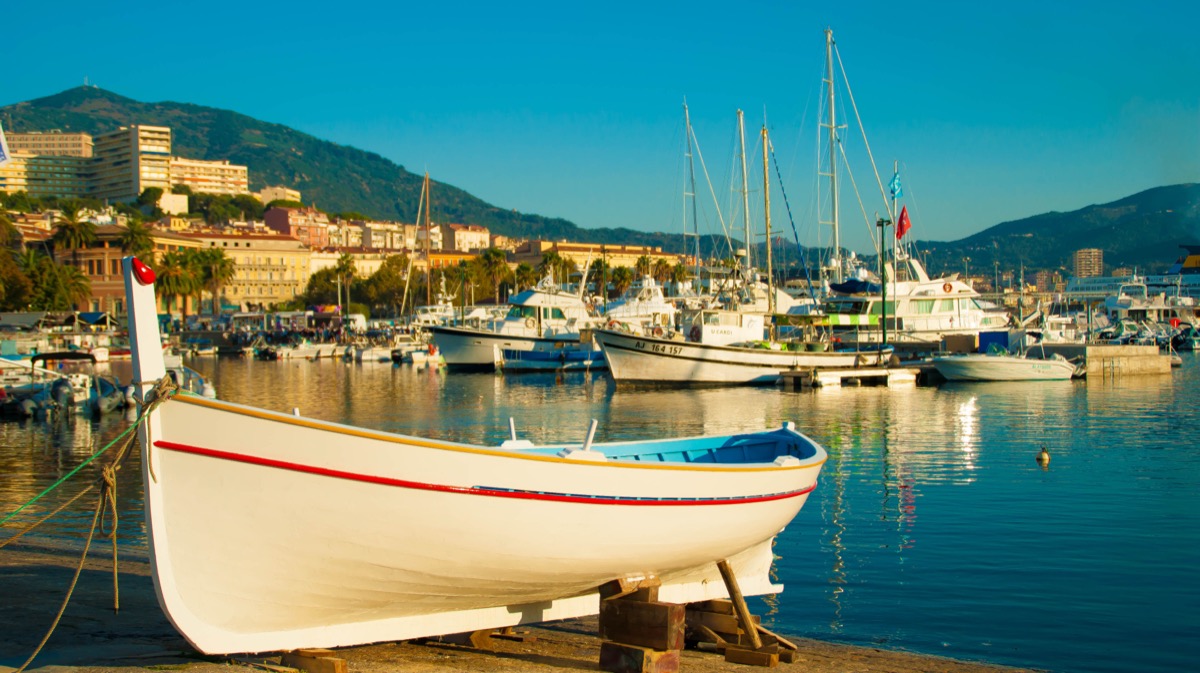
Yes — it is one of the easiest walk-off ports in Sicily. Ships tie up at the Molo Sant'Antonio quay on the mainland side of Porto Grande. From the gangway you walk roughly 300 m along a flat, paved working pier to the port gate, then another 200 m on Via Malta to the Ponte Umbertino, the short stone bridge onto Ortigia. Total time is five to seven minutes at a slow pace. The route is flat the entire way; the only obstacle is crossing one moderately busy road at the bridgehead, which has a signed pedestrian crossing. Once on Ortigia, the Temple of Apollo ruin is immediately on your right and Piazza Duomo is an eight-minute walk through pedestrian-only streets. Mobility-impaired passengers should ask the port agent about the courtesy van some lines run to the Ortigia side of the bridge.
Last verified 2026-05-15. https://www.comune.siracusa.it/index.php/it/turismo
Yes, and visibly so. The Cathedral of Syracuse on Piazza Duomo was built directly into the standing columns of the Temple of Athena, a Doric temple completed around 480 BC after the Greek victory over Carthage at Himera. The temple was converted into a Christian basilica in the 7th century AD by walling in the spaces between the columns rather than tearing the columns down. You can see the original fluted Doric columns embedded in both the north and south side walls of the cathedral interior — twelve are still in place. The baroque facade you see on the square was added after the 1693 earthquake destroyed the medieval front. Entry to the cathedral is €2 and worth it for the columns alone; the square itself, paved in white limestone and ringed by baroque palazzi, is free and is the visual centerpiece of Ortigia.
Last verified 2026-05-15. https://whc.unesco.org/en/list/1200
The Fountain of Arethusa (Fonte Aretusa) is a natural freshwater spring on the southwest seafront of Ortigia, about a four-minute walk from Piazza Duomo. The spring emerges at the very edge of the saltwater harbor and is one of the few places in Europe where papyrus grows in open air outside cultivation — the plants are descended from stock the Arabs introduced in the 9th–10th centuries from Egypt. The Greek myth has Arethusa as a nymph transformed into a spring by Artemis to escape the river god Alpheus, who chased her under the Mediterranean from the Peloponnese. Today the spring is a round, low-walled pool with ducks, the papyrus thicket, and a small adjoining paper museum showing how Sicilian papyrus was once made. Free to view from the surrounding terrace; the spring itself is fenced off.
Last verified 2026-05-15. https://whc.unesco.org/en/list/1200
Yes — it is the other half of Siracusa, the half the Greeks built on the mainland. Neapolis is roughly 3 km from the cruise dock, a 10–12 minute taxi for €12–15 or a 25-minute uphill walk. The park holds the 5th-century-BC Greek theatre carved into the hillside, still used every May–July for the INDA classical drama festival (if your call lands during the festival the theatre is partly seated for performances and views are restricted). The Roman amphitheatre, the altar of Hieron, and the limestone quarries called the Latomie are all inside the same gated park. The Ear of Dionysius — a 23 m-tall cavern shaped like a vertical earlobe with extraordinary acoustics — is inside the largest Latomia and is the single most photographed feature of the park. Entry is €13 (free first Sunday of the month October–March), open 8:30–17:30 in winter and to 19:00 in summer.
Last verified 2026-05-15. https://www.aditusculture.com/musei-monumenti-aree-archeologiche/parco-archeologico-della-neapolis
Yes, if your ship is in by 08:00 and out at 17:00 or later. Noto is the late-baroque town 40 km south of Siracusa, rebuilt entirely after the 1693 Val di Noto earthquake by a single team of architects working in the same warm sandstone — the result is a coordinated baroque streetscape that UNESCO listed jointly with Siracusa in 2002. By car or excursion bus, the drive is 40–45 minutes each way down the SS115. Three hours on the ground covers the main axis: Porta Reale, Corso Vittorio Emanuele, the Cathedral of San Nicolò (collapsed in 1996, fully restored in 2007), and Palazzo Nicolaci with its grotesque-carved balconies. Add an extra hour if you want a granita at Caffè Sicilia — yes, that one, the Bonajuto/Assenza cafe Stanley Tucci put on TV. Skip Noto on a short call (under 6 hours ashore) and do Ortigia + Neapolis instead.
Last verified 2026-05-15. https://whc.unesco.org/en/list/1024
Both, and ideally in that order. Granita is the Sicilian breakfast — a coarse-grain frozen dessert (almond, lemon, coffee, mulberry, pistachio) eaten with a soft brioche bun called a brioche col tuppo that you tear and dip. The Ortigia institution is Caffè Sicilia in Noto if you go south, or Voglia Matta and Bar Midolo in central Ortigia closer to the dock — €3.50–4.50 for granita plus brioche. Arancini are the saffron-rice fritters with ragù, butter, or spinach centers — Siracusa serves the conical shape (the Catania form) rather than the round Palermo version, and the local debate over whether the noun is masculine arancino or feminine arancina is genuinely heated. Borderi, the famous deli on Via Emanuele de Benedictis in the Ortigia market, builds €8–12 sandwiches the size of a forearm and has a two-hour queue by 11:00 — go at opening (08:30) or skip it.
Last verified 2026-05-15. https://www.italia.it/en/sicily/syracuse
Verification — Dock status (two alongside berths at Molo Sant'Antonio, no tender) verified against the Autorità di Sistema Portuale del Mare di Sicilia Orientale port-of-Siracusa page. Cathedral-on-temple history (Temple of Athena c. 480 BC, 7th-century conversion to Christian basilica, twelve Doric columns visible in side walls) verified against the UNESCO World Heritage listing for Syracuse and the Necropolis of Pantalica (ref 1200, 2005). Fountain of Arethusa papyrus origin (Arab introduction 9th–10th c. from Egypt) cross-checked against the Museo del Papiro Siracusa. Neapolis Archaeological Park entry fee (€13), opening hours, and INDA classical drama festival (May–July at the Greek theatre) verified against the Aditus Culture ticketing site that manages the park. Noto restoration timeline (1693 earthquake, San Nicolò cathedral collapse 1996, restoration completed 2007) and joint UNESCO listing with the Late Baroque Towns of the Val di Noto (ref 1024, 2002) verified against UNESCO. Taxi rates and Uber non-operation in Sicily cross-checked against current Radio Taxi Siracusa published rates and Italian rideshare licensing law. Currency, IVA, and tipping practice are standard Italian.
Last verified 2026-05-15